
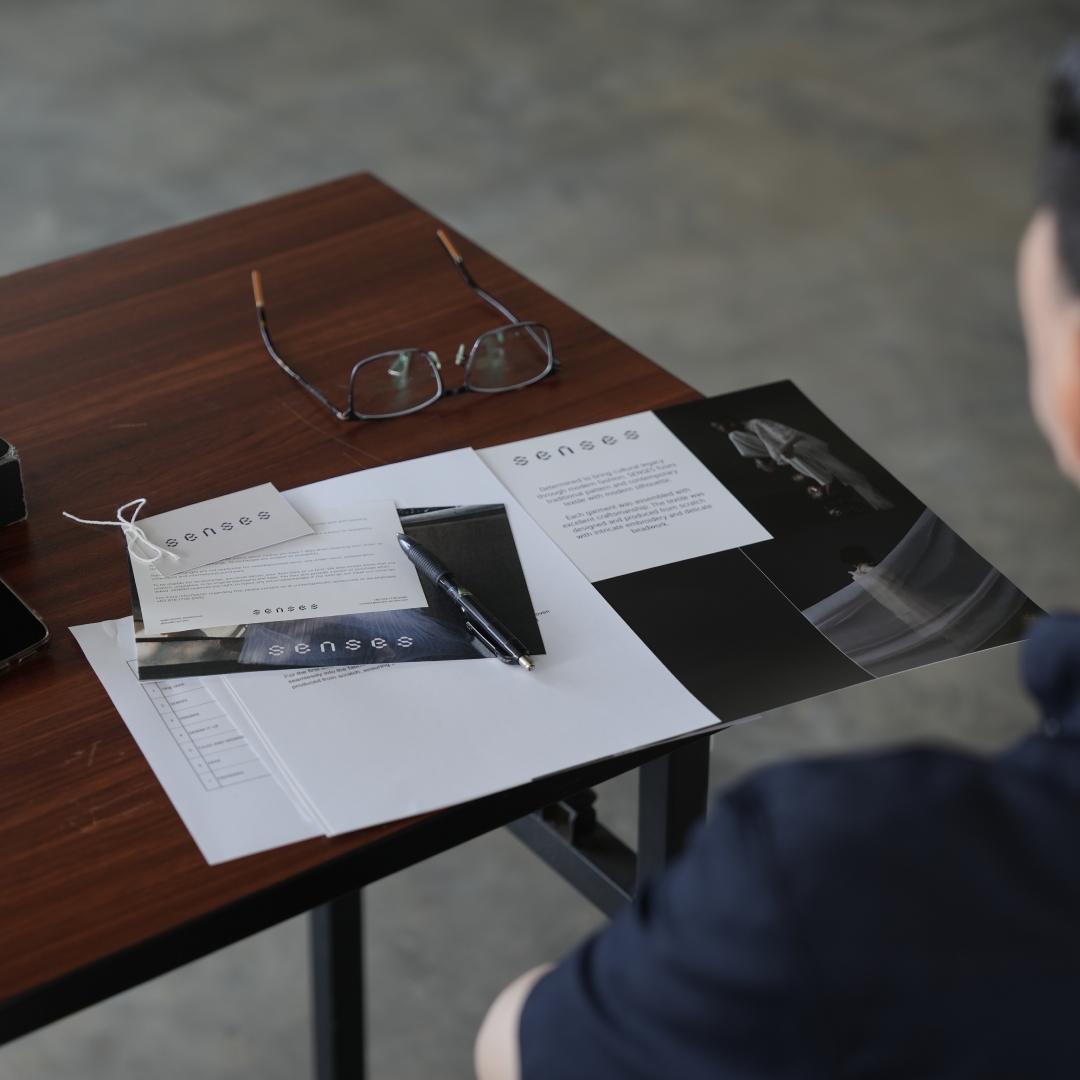
Photo: Creativity gets you in the room. Structure determines what happens next. A mentor assesses SENSES' brand materials at the PINTU second curation session
4 March 2026
When Creativity Isn’t Enough: How PINTU Sets the Standard for Fashion Brand Readiness
Highlight
In today’s accelerated fashion economy, creativity may spark attention, but structure determines survival. As Indonesian brands gain visibility and aspire to compete globally, the real test begins after exposure arrives. This is where PINTU sets itself apart. Not as a short-term accelerator, but as a selective, standards-driven incubator designed to prepare brands for the realities of the global fashion industry.
Visibility is not longevity. A brand may trend overnight, accumulate orders, and build a digital momentum, yet collapse under operational pressure. Inconsistent production, unclear pricing logic, fragile legal frameworks, and reactive growth strategies remain the silent factors that destabilize promising labels. In a market shaped by speed and replication, preparedness is the only sustainable advantage.
Indonesia is rich with creative talent. Designers bring compelling aesthetics and strong technical instincts to the industry. The challenge begins when popularity must translate into operational consistency. Production planning, cost discipline, supplier coordination, and distribution strategy require competencies beyond design. When these foundations are fragile, exposure creates pressure rather than stability.
PINTU was built precisely to address this gap.
Theresia Mareta, founder of LAKON Indonesia and co-founder of PINTU, has long observed how many emerging brands enter the industry driven by strong creative instinct but limited structural preparation. As she notes, “Wise buyers won’t give support carelessly. They won’t buy just anything. They choose products that truly suit them and offer good quality.” Emerging labels, in other words, are not only competing for visibility, but for trust.
Elevating Creativity with Structure
Not every founder enters fashion through a conventional pathway. Several brands within PINTU reflect this diversity of origin. CLV was founded by a designer with a background in industrial and product design. Tales and Wonder emerged from a business-marketing professional. Parapohon was initiated by a former graphic designer, while Bertjorak was established by a founder trained in Chinese Language studies.
These varied backgrounds bring fresh perspectives into the industry. Creativity, clearly, is not confined to fashion schools. What often requires development is not vision, but structural preparation.

Photo: (left to right) Four Indonesian brands, one global stage. Lakon Indonesia, Apakabar, FUGUKU, and Bertjorak at the Paris Trade Show 2023, proof that creative ambition backed by structure travels far
PINTU does not aim to correct creativity; it anchors it within a strategic framework. The program integrates structured mentorship in business strategy, financial literacy, legal and export frameworks, merchandising, and international market positioning. This is not theoretical guidance, it is applied knowledge delivered by industry practitioners operating at global standards.
The Incubation Program focuses on strengthening brand identity, operational discipline, and production consistency. Its culmination is a curated presentation at JF3 Fashion Festival, where brands are evaluated not only on aesthetics, but on execution, clarity of positioning, and structural readiness. This stage ensures that creative direction is supported by the business foundation.
For brands that demonstrate readiness beyond this level, the journey advances to the Acceleration Program. Here, the focus shifts toward international competitiveness, refining export systems, pricing architecture, buyer communication, and cross-border coordination. The goal of this stage is participation in global platforms such as the Paris Trade Show, where production reliability and strategic positioning determine long-term opportunity.
Cross-border engagement, within PINTU’s framework, is not a starting point. It is earned progression.

Photo: Mentorship at PINTU is hands-on by design. Thresia Mareta and Susan Budihardjo reviews brand materials with an incubee, bringing global standards directly into the room
Mentorship Aligned with Global Standards
What differentiates PINTU is the level at which it operates.
PINTU engages decision-makers and industry architects whose experience is embedded within global luxury systems. Strategic marketing insights have been shared by Irwan Mussry, President Director and CEO of Time International, representing global houses including Rolex, Dior, and Chanel. Export and legal frameworks have been addressed by Yosua Yosafat, Managing Partner of Key Partnership Legal Service. Financial literacy sessions have been guided by Ari Handojo, founder of INTRAS. Operational and trade logistics discussions are reinforced by professionals experienced in cross-border systems.
This mentorship is not symbolic. It reflects alignment with international industry standards. Brands are prepared not for short-term recognition, but for competitive participation in global fashion ecosystems.
Theresia Mareta has observed this pattern repeatedly. Many designers demonstrate bold creative ambition, yet struggle to transform that energy into long-term structure.
“The role of PINTU is to open perspectives,” she explains. “I repeatedly heard the same ambitions, a desire to grow, a strong creative drive, and the potential to become serious players in the international fashion industry. Yet despite the years that have passed, progress often feels slow and, at times, challenging.”
From her perspective, the issue is not talent. “The main issue lies in the business vision, a business vision that is often not carefully thought through or planned for the long term.”
Selective by Design
PINTU’s selection process mirrors the standards it upholds. The program is structured for brands that demonstrate both creative identity and the willingness to build sustainable systems. It is not a platform for experimentation without accountability. It is an ecosystem for founders prepared to translate vision into viable infrastructure.
Acceptance into PINTU signals more than potential, it signals preparedness for scale.
Through phased development, brands refine internal systems, strengthen supply chains, sharpen positioning, and prepare for International participation, including entry into the Paris Trade Show, becoming a strategic step toward long-term market positioning rather than a symbolic milestone.

Photo : Lil Public at the Paris Trade Show 2025. A brand that did not just show up, but showed up ready
The Standard for What Comes Next
Through phased development, brands refine internal systems, strengthen supply chains, sharpen positioning, and prepare for disciplined global entry. Each stage builds toward structural resilience rather than premature market expansion.
As Thresia Mareta emphasizes, “A great plan without execution will never deliver optimal results.”
PINTU positions Indonesian brands within this competitive landscape with clarity and discipline. The program reframes incubation as infrastructure, ensuring that growth is supported by structure, and ambition is reinforced by operational strength.
In a global fashion industry that rewards consistency and penalizes fragility, longevity belongs to those who evolve deliberately.
Creativity may attract attention. Structure builds credibility. Execution secures endurance.
And in a competitive global market, the brands that endure are not simply the most visible, they are the most prepared.
That is the standard PINTU sets.